The steamer that has worked the lake since the nineteenth century
One vessel's documented service history traces what the lake was used for, and by whom, across more than a century.
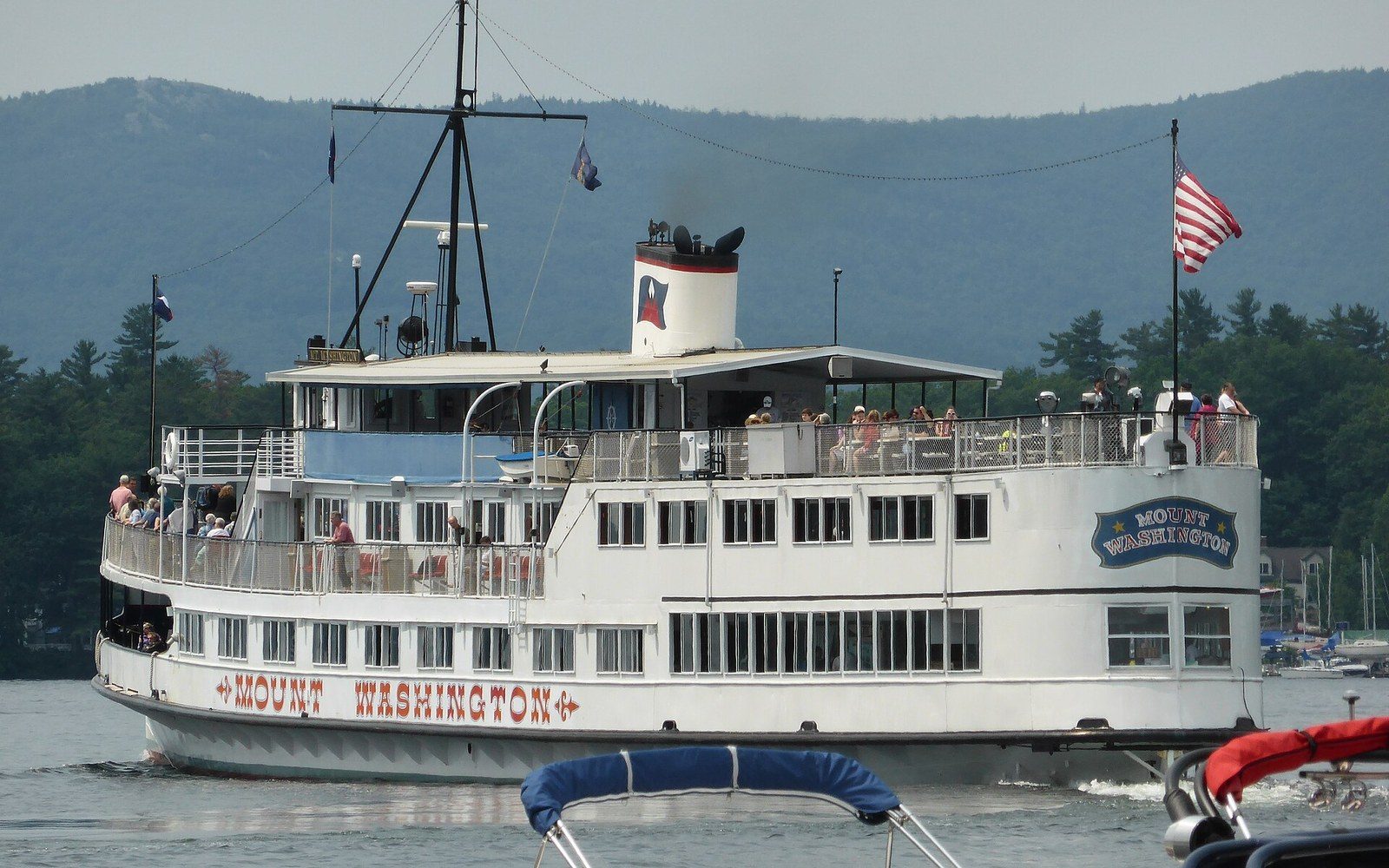
From freight to fashion: the M/S Mount Washington's first century
Lake Winnipesaukee ↗ is not a small lake. At just over seventy square miles of surface, with a shoreline so folded by bays and peninsulas that its measured length runs to about 240 miles, it held communities that had no practical overland connection to one another for much of the nineteenth century. The islands compounded the problem. Bear Island and the other inhabited outliers needed mail, building materials, provisions and passengers moved reliably across water. Before the railroad reached the lake's western shore in the 1840s, water transport was the only transport. Even after rail arrived, the steamboat remained the logical way to reach the lake's interior and its far shore.
The vessel that carries the longest continuous thread through that history is the M/S Mount Washington, which has operated on Lake Winnipesaukee since 1872 in one form or another — though the ship on the water today is not the original hull. The first Mount Washington, a side-wheel steamer, was launched in 1872 and built specifically for passenger and freight service across the lake. It operated out of Alton Bay on the southeastern shore, where the railroad had established a terminus, and its route structure was determined by commerce: mail contracts, hotel provisioning, and the movement of passengers between rail connections and the shoreline communities that the track could not reach.
The railroad's arrival transformed what the steamboat was asked to do. Before rail, lake steamers were general freight carriers. After it, the steamer became increasingly a connector — meeting trains at Alton Bay and distributing passengers to the lake's resorts and islands. This shift is visible in the service records: freight tonnage declined as a proportion of the vessel's load across the 1880s and 1890s, while passenger numbers grew. The branch line from the main Boston and Maine network had made Meredith and Alton Bay accessible from Boston in a single day, and the population that arrived was one with money to spend on summer accommodation rather than work to conduct in a mill.
The first ship burned in 1939 — a fate common enough among wooden vessels with coal-fired boilers — and a replacement was ordered almost immediately. The second Mount Washington was a steel-hulled vessel of substantially larger capacity, launched in 1940, and it is this hull, rebuilt and re-engined multiple times since, that operates today. The rebuilding history is extensive: a major reconstruction in the early 1980s lengthened the vessel, increased its passenger capacity and reconfigured its interior spaces. What is preserved across those changes is not the original material but the name, the route and the function.
Chronology
- 1872First M/S Mount Washington launched, side-wheel steamer, Alton Bay
- 1939Original vessel destroyed by fire
- 1940Second (current) hull launched, steel construction
- Early 1980sMajor reconstruction; hull lengthened, capacity increased
- OngoingDiesel-electric engines replace original steam plant at some point post-1940
The route as a document of the lake's geography
The modern vessel's regular route reads like a survey of Lake Winnipesaukee's settlement pattern. It calls at Weirs Beach on the lake's western side, at Wolfeboro on the eastern, and at Alton Bay to the south, with seasonal variations. Each stop records where population concentrated and why. Weirs Beach grew around the rail terminus and the flat, sheltered ground where the lake drains through the Weirs channel into Paugus Bay; Wolfeboro, on the lake's calmer eastern shore, is documented as the oldest summer resort in the United States, a claim resting on the construction of Governor John Wentworth's summer house there before the American Revolution. Alton Bay was a rail head before it was a resort. The steamer's circuit connects these different histories in a single working day.
Meredith Bay, where the town of Meredith meets the water, is part of this geography. The bay lies on the lake's northwestern arm, sheltered enough for small boat operations and deep enough for the larger steamers that served the late nineteenth century. The relationship between the mill town at the head of the fall and the lake below it was always partly hydraulic — the water that drove the mills at the Waukewan outlet ultimately reached the bay — but it was also commercial. Goods manufactured in the mill block moved out by water as well as by road, and the steamer route was one of the channels through which Meredith's production reached the wider region before the railroad reorganized those flows.
The many islands counted in the lake's basin created a permanent constituency for water transport that no road network could dissolve. Island residents depended on scheduled steamer service for mail delivery well into the twentieth century, a function that gave the Mount Washington a quasi-official character that purely private passenger vessels did not carry. The federal mail contract tied the schedule to a legal obligation rather than to seasonal demand alone, which meant the boat ran in shoulder seasons when commercial logic alone might not have kept it in service.
Hull, engine and the mechanics of a long working life
The practical question of how one vessel name has survived since 1872 is partly answered by the nature of ship ownership and regulation. A vessel's official documentation in the United States is tied to its hull identification, and a major reconstruction — new frames, new plating, lengthened hull — produces in legal terms a rebuilt vessel rather than a new one, allowing the operating history and the name to carry forward. The National Register of Historic Places ↗ does not list the Mount Washington as a historic property, which reflects precisely this ambiguity: the hull is not original, and the vessel's significance is operational rather than fabric-based.
What the route connects
The current engines are diesel, replacing the original steam plant that gave the vessel its generic class name. "Steamer" is now a historical courtesy; the operating configuration is a diesel-electric arrangement typical of mid-sized passenger ferries rebuilt from the 1970s onward. The conversion removed the coal-handling infrastructure that had been a feature of the original operation — coal bunkers, ash handling, the stokers who managed the boiler — and with it a substantial portion of the crew that a nineteenth-century crossing required. A vessel that once carried a working crew of a dozen or more now operates with far fewer hands for a comparable passenger load.
Documentation of the Mount Washington's service history is held in part by the New Hampshire Division of Historical Resources and in part through the records of the Mount Washington Steamship Company and its successors. The Winnipesaukee Historical Society holds photographs, schedules and freight manifests that allow the vessel's route and cargo history to be traced across decades, making it one of the better-documented working boats in the northeastern United States. What those records show, taken together, is less a single ship's biography than a register of what the lake demanded across successive economic eras — freight, then resort passengers, then day-trippers — and how one name was kept current through each transition by the logic of replacing what wore out while preserving what still worked.